
Friday, 28 August 2015
Predicting Precipitation
This was an overview of Ionic Product and we use it to predict if a precipitate will form. Then we looked at what happens when a common ion is added to a saturated solution, for example making a limewater solution more alkaline with sodium hydroxide.


Thursday, 27 August 2015
Solubility Product
There is a relationship between the Solubility Product and solubility (in mol L-1). We also need to remember n = m/MR and c = n/V for calculations regarding solubility.


Aqueous Solution Introduction
We started the lesson with an overview of the aqueous solution topic, linking it to the chemical reactivity topic from last year:

In the worked example above, we use an equilibrium equation to show the sparingly soluble nature of copper (II) carbonate. This means that we can write an equilibrium expression for it, called the solubility product.
One of the ions made can actually act as a base, making the solution slightly alkaline. We can show this with another equilibrium equation (as it is a weak base). Again, there is an equilibrium expression for this, called the base constant.
The base (carbonate) and its conjugate acid (hydrogen carbonate) can be put together in similar concentrations to create a solution called a buffer. Buffer solutions can resist changes in temperature and pH due to the presence of both the base and its conjugate acid (or vice versa).
Friday, 7 August 2015
Revision Questions
With school exams just around the corner, here are some questions to jog your memory:


Tuesday, 28 July 2015
Electrochemical Cells
We have already met the concept that spontaneous reactions have a positive net electrode (reduction) potential. It would make sense, therefore, that these chemical reactions generate a voltage (electricity).
Electrochemical cells comprise of two half-cells, one where oxidation occurs and one where reduction occurs. There are conventions for writing cell diagrams, which we need to understand.


Electrochemical cells comprise of two half-cells, one where oxidation occurs and one where reduction occurs. There are conventions for writing cell diagrams, which we need to understand.


Monday, 27 July 2015
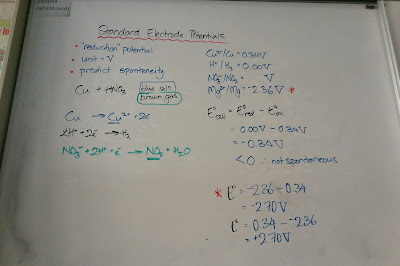
Electrode Potential Calculations
We are expected to go over the theory behind electrode potentials ourselves, but we were shown how to use these values to justify if a reaction is spontaneous or not.

Identifying Species
Sometimes, it is unclear which species have been produced. We can use electrode potentials to justify which species are made, but some qualitative tests also help:


Subscribe to:
Posts (Atom)