Friday, 16 October 2015

Equivalence Point pH


STEP ONE: Write a balanced equation for what has happened at the equivalence point. This is not an equilibrium reaction, it is neutralisation.

STEP TWO: Use the n, c, V relationship to calculate the concentration of the conjugate being formed in the neutralisation reaction.

STEP THREE: Write an equation for the dissociation of the conjugate with water.

STEP FOUR: Use the weak base (or weak acid) calculations, as appropriate, to find the concentration of hydronium ions.

STEP FIVE: Use this concentration to calculate pH.

Thursday, 15 October 2015

Titration Curves

During a titration, the pH does not change uniformly. There are key points that can be calculated, and the remainder of the curve can be sketched from these:

Initial pH

This example starts with a weak acid in the conical flask. If it were a weak base, the calculations are a lot harder, but you can refer to THIS for how to do that calculation.


Equivalence Volume and Half-Equivalence Point

This relies on a good memory of the titration topic from last year. Once you know the equivalence volume, you are ready to mark the pH of the half-equivalence volume (pKa = pH).


Final pH

This is very easy if you remember how to calculate the pH of a strong base (in this example). Put all of these points together to sketch the shape of the curve.


Equivalence Point pH

This is very hard and seldom asked in NCEA. Having said that, maybe this is the year that it will be asked...

We will cover this in Friday's lesson and dedicate an entire blog post to it.


Saturday, 10 October 2015

Buffers

The first things we need to master about buffers:
  1. Define a buffer
  2. Explain how a buffer works
  3. Calculate the pH of buffer solutions

On Mondays lesson, we can use our workbooks (Continuing Chemistry), and the internet as our resources, as well as the following videos:


Our next step is to work out how to make a buffer of a desired pH...

Thursday, 17 September 2015

pH of Weak Bases

Whenever these questions are asked, they are worth Excellence. This is because there are six key steps to remember, and they need to be remembered in order!

  1. Write out the equation for the base acting as a an alkaline solution.
  2. Write a Kb expression.
  3. Calculate Kb from Ka
  4. Calculate [OH-] from the Kb expression (assuming [HB+] = [OH-]
  5. Calculate [H3O+] from [OH-], using KW
  6. Calculate pH

This video is very long, so use it to work through an example, rather than trying to learn it all in one go:


Monday, 14 September 2015

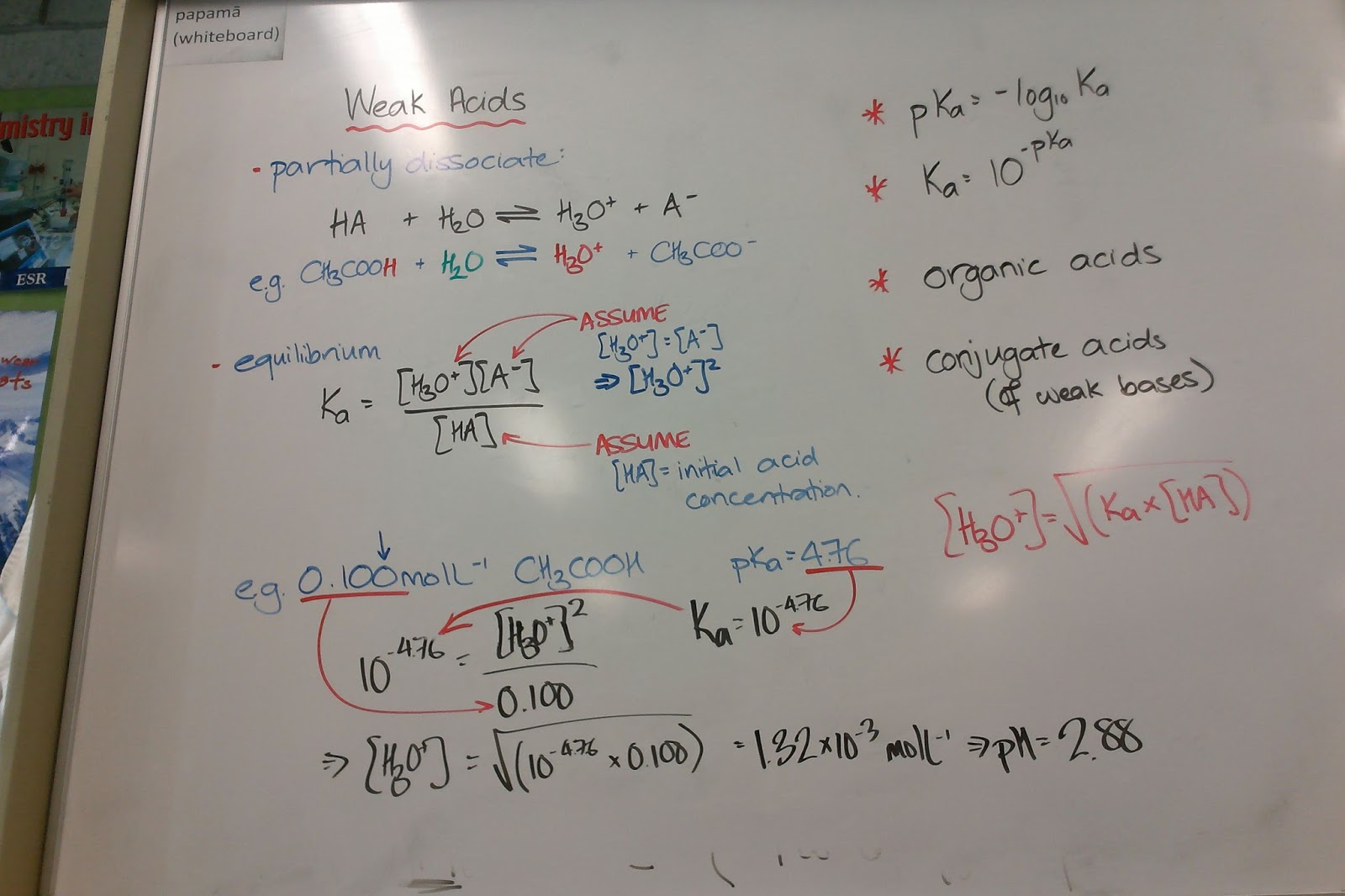
pH of Weak Acids

Weak acids only partially dissociate, so how do we calculate their pH?


We were encouraged to work through pp180-181 in Continuing Chemistry to check whether or not we have understood this.

Thursday, 10 September 2015

pH of Strong Acids and Bases

This is just a recap of last year, but these skills are vital for moving forward in this topic:


Here is the concept being taught to a Year 12 class:


Tuesday, 8 September 2015

Acids, Bases and Salts

We started with a recap of the Bronsted-Lowry definitions of acids, bases and amphiprotic species:


Then, we looked at the pH of some salts, comparing them to a control of NaCl (known to have a pH of 7.0):


We need to write chemical equations for the ions to justify the observed pH values (alkaline or acidic):


For example:
HCO3- + H2O <=> H2CO3 + OH-
This equation shows an increase in [OH-], which is expected as the pH > 7.0

Friday, 28 August 2015

Predicting Precipitation

This was an overview of Ionic Product and we use it to predict if a precipitate will form. Then we looked at what happens when a common ion is added to a saturated solution, for example making a limewater solution more alkaline with sodium hydroxide.


Thursday, 27 August 2015

Solubility Product

There is a relationship between the Solubility Product and solubility (in mol L-1). We also need to remember n = m/MR and c = n/V for calculations regarding solubility.


Aqueous Solution Introduction

We started the lesson with an overview of the aqueous solution topic, linking it to the chemical reactivity topic from last year:


In the worked example above, we use an equilibrium equation to show the sparingly soluble nature of copper (II) carbonate. This means that we can write an equilibrium expression for it, called the solubility product.

One of the ions made can actually act as a base, making the solution slightly alkaline. We can show this with another equilibrium equation (as it is a weak base). Again, there is an equilibrium expression for this, called the base constant.

The base (carbonate) and its conjugate acid (hydrogen carbonate) can be put together in similar concentrations to create a solution called a buffer. Buffer solutions can resist changes in temperature and pH due to the presence of both the base and its conjugate acid (or vice versa).

Friday, 7 August 2015

Revision Questions

With school exams just around the corner, here are some questions to jog your memory:


Tuesday, 28 July 2015

Electrochemical Cells

We have already met the concept that spontaneous reactions have a positive net electrode (reduction) potential. It would make sense, therefore, that these chemical reactions generate a voltage (electricity).

Electrochemical cells comprise of two half-cells, one where oxidation occurs and one where reduction occurs. There are conventions for writing cell diagrams, which we need to understand.


Monday, 27 July 2015

Electrode Potential Calculations

We are expected to go over the theory behind electrode potentials ourselves, but we were shown how to use these values to justify if a reaction is spontaneous or not.


Identifying Species

Sometimes, it is unclear which species have been produced. We can use electrode potentials to justify which species are made, but some qualitative tests also help:


Friday, 24 July 2015

Half Equations

We started by looking at the reactions of potassium permangate under different conditions. This video shows the results:


We also need to know how to balance the half equations for these reactions:


Thursday, 23 July 2015

Half Equations

Another recap of Level 2 work...


If you want some help learning your redox pairs, try these FLASH CARDS
These FLASH CARDS are also excellent.

Oxidation Numbers

This is just a recap of last year's work. The allocation of oxidation numbers:


Oxidation-Reduction Introduction

Today was a recap of the key elements of Level 2 Redox that will be important to use for the topic and assessment in Level 3:


Friday, 26 June 2015

Bonding Types

We have met types of bonding already, but we need to be more specific about "inter-molecular bonding". Once we classify what type of bonding a substance can make, we can use this to explain physical properties such as melting point trends or molar heat of vaporisation trends.


Thursday, 25 June 2015

Polarity

This is a very quick overview for how to work out if a molecule is polar or not: